America lost. Russia won. A global disinformation campaign which emerged stronger than ever before during the past two decades found its ultimate conclusion with the re-election of Donald Trump as the President of the United States. How permanent this damage is, remains to be seen.
This is a bold statement, some might say. But it’s not something I fabricated out of thin air. It’s what the man who played a crucial role in shaping this world said so himself.
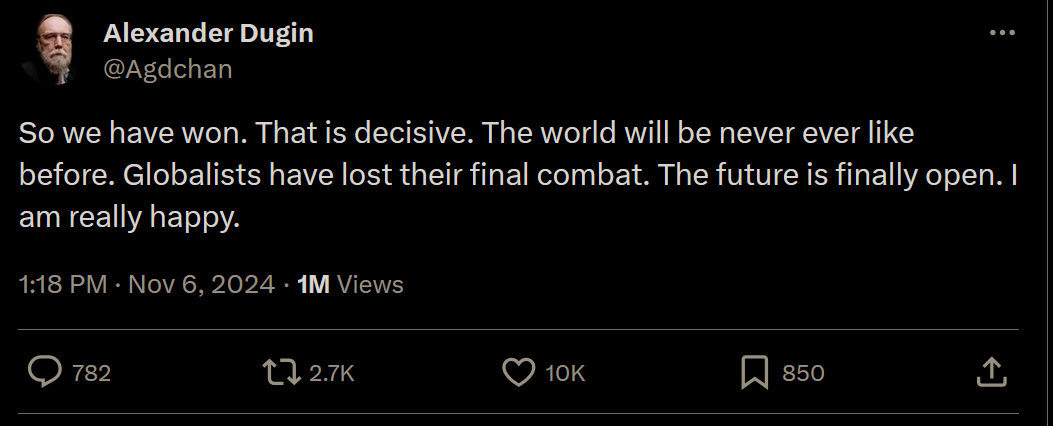
Who is Alexander Dugin? Glad you asked.
The Man Who Set The World On Fire
Before I proceed, a note of caution:
A lot of what I’m going to say here is circumstantial and speculative. Intelligence agencies weren’t really good at their job, if proving their involvement beyond doubt was going to be easy. Some evidence exists but not everything will be as clear cut. But if one of the most influential Russian intellectuals of the past century openly states that they won, it should give food for thought.
I hinted at it in my previous essay and initially I wanted to take a bit more time to refine my thoughts on the matter, but I feel like it’s crucial to get this out into the world sooner rather than later. Even if I only reach a few hundred people, that’s still better than doing nothing.
Much of what Western societies have experienced during the past two decades can be traced back to a single point in time. 1997, to be precise.
In that year, Dugin published his magnum opus, the “Foundations of Geopolitics; The Geopolitical Future of Russia”, which became pretty much the playbook for Russia’s foreign policies ever since.
Across 600 pages, he explains in detail how to wage an extensive hybrid war, emphasizing the importance of the invasion of Georgia, the annexation of Ukraine, and how to weaken NATO and the EU alike. Remember Brexit? It’s relatively safe to assume that Russian intelligence services used their vast resources to unleash targeted social media campaigns and other methods of information warfare to tip the balance in favour of the UK leaving the EU.
Ever wondered how, especially in the US but many other Western countries as well the social divide seems to grow larger and larger every year?
By now, Russian interference in the 2016 US election has been confirmed and it shouldn’t surprise anyone if an intelligence committee will find similar things for the one in 2024. Although I wouldn’t hold my breath on that one, given the person who is now going to take office. The thing is though, the majority of the work was already done. For two decades now, the fundamentals of Western ideas, the very core of what makes our way of life so great, have been targeted and systematically shattered by a disinformation campaign so vast, it’s difficult to grasp the full scope of it.
But it’s pretty much what you could expect when a state actor with almost unlimited resources decides to attack the fundamental values of another society. Given enough time and not enough counterintelligence, slowly convincing members of the enemy society that they are actually the bad guys, is not an unlikely outcome.
Or as Dugin puts it:
Thus, at present, the geopolitical problem of the planetary West, in its broadest sense, breaks down for Russia into two components the West as America and the West as Europe. In geopolitical terms, the two realities have different meanings. The West as America is Russia’s total geopolitical adversary, the pole of the direct opposite trend to Eurasia, the headquarters and centre of Atlanticism. Positional geopolitical warfare with America has constituted the essence of all Eurasian geopolitics since the mid-twentieth century, when the role of the United States became obvious. In this regard, the position is clear: it is necessary to counteract US Atlanticist geopolitics at all levels and in all regions of the world, trying to weaken, demoralise, deceive and, ultimately, defeat the enemy as much as possible. It is especially important to bring geopolitical turmoil into the US domestic reality by encouraging all kinds of separatism, various ethnic, social and racial conflicts, actively supporting all dissident movements of extremist, racist and sectarian groups that destabilize internal political processes in the USA. At the same time, it makes sense to support isolationist tendencies in US politics, the theses of those (often right-wing Republican) circles that believe that the US should confine itself to its domestic problems. This state of affairs is highly advantageous to Russia, even if “isolationism” is carried out within the original Monroe Doctrine wording, i.e. if the US limits its influence to two Americas.
–Foundation of Geopolitics, 358-359, Translation by Lawless v0 2022-02-26.
Original version from Russian, Moscow, Arktogeia, 2000.
It’s no coincidence that we see an increase in social division in so many areas of life. Does that mean that every shitty thing that happened in the past two decades is Russia’s fault? Of course not, the world is a tad more complex than that. But Russia (and other malignant actors) are masters at their craft when it comes to exploiting divisive issues and stoking the flames.
In a time when online discourse and social media have become huge catalysts for rampant misinformation and emotional outrage, it’s not really surprising that we have people chanting in the streets and shouting support for genocidal terrorists like Hamas, Hezbollah and others.
It’s also not surprising that we have a different crowd of people shouting to deport all migrants or sometimes even worse (I have a few thoughts on that as well, but later).
Every society has problems, and until our AI overlords take over, this won’t change. But often enough, these problems are being amplified and exaggerated by actors with clearly problematic interests in mind. What many people don’t realize is that they are merely pawns in a game of much, much larger scale. Especially the extremists on both sides of the aisle are just useful idiots for Dugin and his masters. And now, America crowned one of them as their “king above the law” (not my words but from Justice Sonia Sotomayor about the recent Supreme Court ruling). Don’t believe me? I’ll let Dugin explain it once more:
Most of the controversy over the new geopolitical picture of the world revolves around three fundamental categories:
1) The ”Etat-Nation”, i.e. the traditional historically centralist state (such as France, Italy, Germany, Spain, etc.);
2) Region, i.e. an administrative, ethnic or cultural space that is part of one or more nation states (Etat-Nation), but which has a significant degree of cultural and economic autonomy (e.g. Brittany in France, Flanders in Belgium, Catalonia, Galicia and the Basque Country in Spain, etc.);
3) The Greater Space, a “commonwealth” or “community” that brings together several nation-states (“Etat-Nation”) into a single economic or political bloc.
Many “Europeanists”, both on the left and on the right, believe that the category of the “nation-state” (Etat-Nation) (The Etat-Nation, i.e. the traditional centralist state, has become obsolete and that the focus should be on the other two modalities, regionalism and even autonomism, on the one hand, and the continental unification of the regions into a single block, on the other. It is telling that the points of view of the polar political spectrums converge here: The “New Left” sees Etat-Nation as too “right-wing”, too “totalitarian” and “repressive”, too “conservative”, an entity which should be abandoned in the name of progress, while the “New Right”, in contrast, sees this same state-nation (Etat-Nation) as too “modernist”, too anti-traditional in European history, when the truly traditional European Empire was destroyed by a nihilistic and secular French absolutism. Furthermore, the New Right sees in regionalism a return to ethnic traditions and to the principle of ethno-cultural differentiation, which is the axis of all “New Right” thought. On the other hand, there is a rather broad category of politicians who, on the contrary, uphold the values of the Etat-Nation (Etat-Nation). Again, a commitment to state-centrism can unite both the “right” and the “left”. As a rule, however, it is not the “new”, but the “old” right and left that stand on this position. Characteristically, in France, the opponents of European unification were three political forces: Le Pen’s Front National (extreme right), the Marché Communists (extreme left) and Jean-Pierre Chevenman’s centrist socialists with national sympathies. It follows that the most distant ideological and political sympathies can be combined within the same geopolitical project.
-Foundation of Geopolitics, 399-400, Translation by Lawless v0 2022-02-26.
Original version from Russian, Moscow, Arktogeia, 2000.
The extreme left and the extreme right, sometimes even knowingly, both played their role in accordance with whatever Russia deemed important. We have evidence of huge networks of influencers being paid by Russia to further its agenda and increase division among the citizens of Western societies.
We have evidence of Russia (and China) trying to strengthen the political Moscow-Berlin axis Dugin speaks about in his book.
Months ago, DER SPIEGEL exposed the secret connections of a man who had worked for AfD members of parliament for years to the Moscow power apparatus. Then, a few weeks ago, the Czech government announced that it had uncovered a Russian influence operation. Several European intelligence services had helped to unmask the Russian plan.
They say that the media portal Voice of Europe had been used by Russia to spread propaganda in 16 languages. Money also reportedly flowed through the company to European politicians with right-wing extremist parties. And the names of two German politicians soon emerged: Maximilian Krah and Petr Bystron, numbers one and two on the AfD list for the upcoming European Parliament elections.
Reporting by DER SPIEGEL has found that Voice of Europe appears to be but a small part of a large-scale Russian operation in which the AfD plays a central role.
Or as Dugin wrote more than twenty years ago:
The Moscow-Berlin axis would help to solve a whole range of critical problems that both Russia and Germany face today. In such an alliance, Russia gains direct access to high-tech and powerful investments in industry and gains guaranteed European complicity in the economic rise of the Russian states. There will be no economic dependence on Germany, because Germany will not participate in Russia as a benefactor, but as an equal partner, receiving in return a strategic cover from Moscow which guarantees Germany political freedom from US dominance and resource independence from the Third World’s energy reserves controlled by Atlanticism (this is the basis of US energy blackmailing of Europe). Germany today is an economic giant and a political dwarf. Russia is, to the contrary, a political giant and an economic cripple. The Moscow-Berlin axis will cure the ailment of both partners and lay the foundation for the future prosperity of a Great Russia and a Great Germany. In the long run, it will lead to the formation of a solid strategic and economic structure for the creation of an entire Eurasian empire, a European empire in the West and a Russian empire in the East of Eurasia.Foundation of Geopolitics, 219, Translation by Lawless v0 2022-02-26.
Original version from Russian, Moscow, Arktogeia, 2000.
We have evidence of large-scale disinformation campaigns, including creating fake narratives by cloning websites of popular news outlets.
This campaign employs generative AI to create disinformation content and purchased domain names similar to legitimate media to mimic news outlets, governments, and think tanks, luring unsuspecting readers into a maze of falsehoods. At least 17 media providers, including Bild, 20minutes, Ansa, The Guardian, and RBC Ukraine, have been exploited to spread DoppelGänger’s pro-Russian narratives.
And these are just some of the most prominent cases and of which we actually have clear evidence. It’s not unreasonable to assume that not every intelligence operation orchestrated by Moscow is going to be discovered but the impact has become very real and provides a disturbing look into a possible future.
But earlier I spoke of hybrid warfare. Intelligence operations and disinformation campaigns are just one side of the coin. The other one is putting boots on the ground and creating the desired reality.
Migration As Weapon
As I said earlier, Russia is not the omniscient mastermind behind every shitty thing that has happened in recent history. But it’s pretty damn good in exploiting them to its advantage. Look no further than 2015.
In this year Russia started its armed intervention after the request of Bashar al-Assad. Probably needed some help to keep butchering his own people. The resulting migration crisis which hit Europe in the same year was probably not intended but still a most welcome consequence for Moscow’s geopolitical goals.
No country in Europe was ready for that but most of them felt they had a moral obligation to help those in need. Especially after Germany’s chancellor Merkel at that time basically spoke out an open invitation. And why not? Europe was rich and secure, it surely had the resources to help people who needed it the most. What could go wrong?
Tragically, so, so many things. Not only did it turn out to be very difficult to keep track of everyone arriving at Europe’s shores, but an even greater challenge was how to integrate millions of new people into a society culturally very different from their countries of origin.
Putting people into large camps with questionable health and security conditions, having laws in place which prevented many from acquiring legal ways to work and few feasible ways of making sure everyone who came understand what they signed up for will lead to tensions. Europe is a great place with a lot of freedoms, but these freedoms have to be secured by ensuring people know their duties and limits as well.
This is why we have to talk about the idea of culture itself.
The Illusion of Multiculturalism
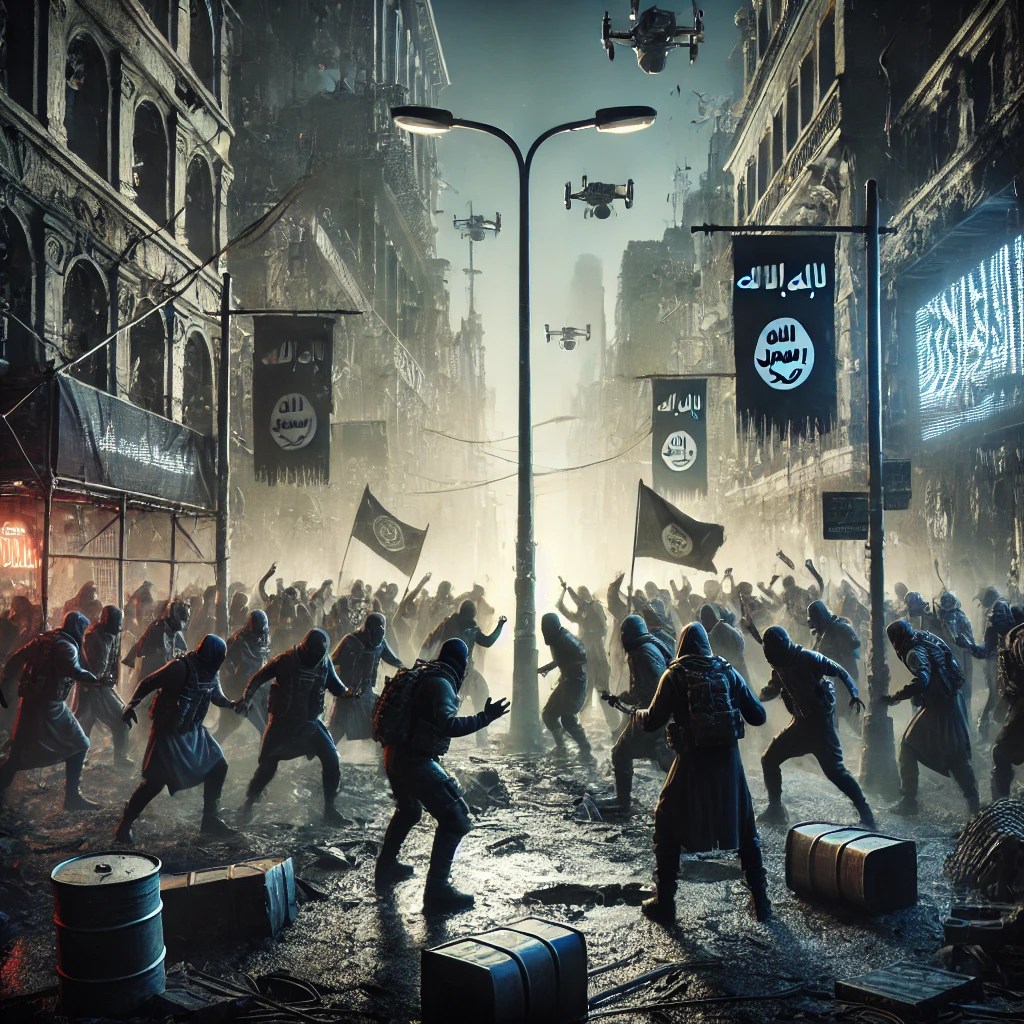
Once, we were all somebody else. Me included. Before my libertarian enlightenment I used to run with people on the far left, pro-socialism crowd. To this day, many of my friends are still very left-leaning and I found my peace with the fact that we will probably never see eye to eye on many political and economic issues.
The reason I included this short throwback is simple. I once believed that multiculturalism could work as well. I went even further, I openly defended moral relativism, and that rights and freedoms are mainly a matter of perspective and cultural heritage. Obviously, my position has changed quite considerably.
I think it’s important to accurately define what I mean when I speak of multiculturalism and its counterpart monoculturalism. Otherwise, people will throw me into a category I simply don’t belong to.
Culture itself contains so many variables it’s difficult to distinguish them all. Ask a hundred different people and you will probably hear at least seventy different answers about what they think the culture of their nation might be. I’m certainly going to disagree with many other people who were born here. Therefore, I deem it rather useless to try to find an exhaustive definition of culture, because something for someone will always be missing.
Instead, I prefer a minimalistic approach.
Culture should be defined as a set of fundamental core values to which everyone who is part of it can subscribe to. For Western societies these are evidently universal human rights, human dignity and all their associated freedoms and duties. This is the ideal.
I’m fully aware that there are many examples of Western nations failing to meet this ideal. But fundamentally, we all can agree that we should keep striving for it regardless of past failures. It’s a worthwhile pursuit and an integral part of ensuring a prosperous society.
The moment someone disagrees with these core values, they split from the dominant culture and create a counterculture, thus creating a multicultural chasm. But as long as people agree with the core values of a society, it does not matter whether they were born into it or migrated from somewhere else. None of their other beliefs, identity, race, gender, whatever matters as long as their submission under the core values of the society they chose as their home is guaranteed.
And this is where it becomes complicated.
It is not unreasonable to assume that many people who were affected by the wars in their home countries had other things in mind than to ensure their values aligned with the country they are fleeing to. Mainly: survive at all costs.
Which is only human. I doubt I’d bother much with these thoughts if I had to figure out ways to not get shot. Philosophy is the luxury of a rich and secure society. I’m immensely grateful for this privilege.
Alas, life is not fair. Many people who fled and found new homes in Western countries quickly started to appreciate their new lives and the opportunities they brought. The very people who understood and subscribed to the core values of Western culture.
But not everyone wants to be part of it. Tensions have been rising for years but especially since the terror attack on October 7th in Israel. Tens of thousands of people openly chanting in the streets, calling for the genocide of Jews and demanding a global caliphate. Jews were being openly hunted in European streets just yesterday in Amsterdam.
It is no surprise that more and more people across European nations demand action from their political leaders. The rise of far-right parties is no coincidence. People are losing trust in established parties and institutions. Civil unrest increases in many Western nations.
This is a problem. Something that cannot and should not be ignored. A problem for which political leaders need effective solutions sooner rather than later. Preferably, the ones who aren’t being paid or otherwise supported by Russia or China. Which excludes pretty much all of the extreme right and left. But if the reasonable, Western aligned political leaders are not willing or capable of finding a solution, it’s only a matter of time until they are replaced by more and more extreme alternatives. We already see how much popularity extremist parties all over Europe are gaining.
Trump’s decisive victory was not a coincidence, it was a symptom of a much, much larger problem.
The Way Ahead
Speaking of it, let’s take a look at America and its possible future.
Obviously, everything I’m going to say now is pure guesswork combined with some naïve hope.
For many Americans Trump’s second term will be rough, I don’t think there’s a way around it. Be it the moment they start to realize that tariffs do not work at all how Trump thinks they work, the worsening of (reproductive) healthcare or a reduction of civil liberties. This time, there won’t be as many people around to keep his worst impulses in check. Instead, it will be a bunch of cronies, bootlickers and rich puppeteers.
There will possibly new nominations for the Supreme Court, which is already biased towards Republicans and will now stay that way for at least the next generation.
Trump will also not be the big strong man many of his followers idealize him as. It is no coincidence that many autocrats around the world and Putin, of course, wanted him to take office. They know very well how easily they can flatter his ego and it’s usually not a big challenge to outsmart him. He is simply no match for a Vladimir Putin or Xi Jinping. Especially Ukraine will now face an even more difficult time, since it’s likely that Trump is drastically going to cut military support.
But.
I have faith in most of the American people and their strength. They will endure; they will prevail. I don’t think (or rather hope) Trump and his allies can deal enough damage to turn American democracy into an idea of the past. In four years, this nightmare will be over and someone else will take over. Someone more competent, empathetic and reasonable. Doesn’t really matter whether they are Democrat or Republican at this point.
But if the Democrats want a realistic shot, they should do some serious introspection. It could be a good idea to re-define their own core values and what makes them so great. Position themselves as the party which celebrates Western liberties and the many great achievements of Western civilization. Take a stand against the terror supporters in their own ranks. Start talking with people and not about or against them. Don’t declare everyone who disagrees with you a nazi or a fascist – unless, of course, they are one. Often enough, people arrive at their conclusions not so much out of malice but due to different information or sometimes sheer incompetence. Have compassion.
Listen when people talk about their daily problems and take them seriously.
One of the biggest mistakes in this election was the Democrat’s ignorance regarding economic concerns. Sure, the stock market looked great. Crypto market as well. If you were an asset owner, you would be well off. But this is simply not the case for many people. They were pissed that their groceries were getting more and more expensive. And Democrats failed to properly communicate how to solve this.
There is this great quote by Jeff Bezos:
When data and anecdotes disagree, it’s usually the anecdote that’s right. Something is wrong with the way you’re measuring your data.
People don’t care about Nvidia hitting all-time-high after all-time-high when they are living paycheck to paycheck and struggling to pay their bills. The world will look different in four years. Maybe darker, maybe brighter. All I can do is hope that the malignant actors who won today will someday lose again.
Never forget what makes Western civilization so great and be grateful to be a part of it.
Never surrender to its enemies from the outside or within.
Never stop fighting for its survival.
Never lose hope.
 Egotheist